

In the last 25+ years, we have seen our share of RFPs, completed many new projects – and we’ve learned a lot. At Windsor, we work solely with governmental environmental agencies with customizable software – but we believe this article could apply to any software business buyer.
As a software buyer or contributor, you are probably very aware of how much work an RFP can be. And, after the RFP, you’ve probably seen how selected vendors don’t always provide the easiest transition nor all the positive changes you wanted.
1. Asking the right RFP questions is key
All buyers list technical and feature requirements, whether it’s formalized through an RFP process or through other means. Despite the technical details, buyers often have ‘surprises’ after the work is awarded. That’s because it’s difficult for even the most astute customer to visualize what all the changes could be for configurable software. Likewise, it’s difficult for any vendor to visualize a buyer’s specific business or workflows like the buyer does.
We’ve always known that we are fully accountable for our client’s satisfaction. To get the most from a new software implementation, the buyer also has an important role. We believe the buyer needs to:
- Have the skills to ask software vendors questions beyond the technical.
- Seek strong collaboration with an awarded vendor – especially early in the planning.
So, in order to lessen surprises with a new software vendor and reap the most benefits we recommend adding into the RFP more questions about how a vendor will address moving you towards your desired result.
Also, new solutions often improve current business practices and processes, so it’s best to not stipulate exactly how the solution should be implemented with all technical specificity. If you do, you could miss out on more improvements. As one analogy, imagine that you are a homeowner getting a proposal from a residential architect.
You could ask: “The house addition must be exactly 15’ x 35’ and for a limited budget. Can you do it and what is your best estimate?”
A better question could be: “We want a new family room addition for gatherings of 4 to 10 people that feels casual, intimate but has lots of natural light that also leverages the view. We’re thinking the addition could be approximately 15’ x 35’ and for a limited budget. What is your design approach and best estimate?”
When you ask the question based on the end result you seek, you invite the vendor to be creative, giving insights into how they could best approach the project services for you.
“The art of proposing a question must be held of higher value than solving it.”
Georg Cantor – Mathematician 1845-1918.
2. Learn more about a vendor’s attitudes and values
How they will engage with you can be very telling. For example, when you hold a meeting to discuss their proposal to your RFP, here are some ideas which may give you insights into how they will work with you. Do they:
- Ask you questions?
- Show an interest in your work?
- Show humility? Is there anything a tad too “opportunistic” about them?
- Tell you about their lessons learned from previous work?
- Have relevant experience in your business area?
- Show how their solution can flex with unexpected requests later on?
- Demonstrate strength in business processes: project planning, Agile-Scrum processes, and quality checks.
The more that a vendor shows their value for collaboration, strong processes, flexibility and being willing partners with you, we believe the more successful the results will be.

3. Seek strong business processes as part of the vendor selection criteria
As a project manager, I am involved in responding to RFPs. Later, I can be assigned that awarded work. I know from first-hand the importance of how a software project is implemented. For example, it doesn’t matter how many features a vendor has: if the ‘features’ are not well configured to the needs of the client, the new software implementation will not be as successful. Services that include strong business processes do not need to cost you more: a good vendor can be even more cost-effective for you because they know how to work ‘smarter’, not ‘harder’.
So what are examples of strong software business processes?
- For Windsor, at the beginning of a project, all project managers take on the same approach: we start with strong collaborative planning. We view the planning phase with each client as vital to the success of each project.
- Then we use formal business processes throughout, which we have learned, to help our clients get the most out of their software.
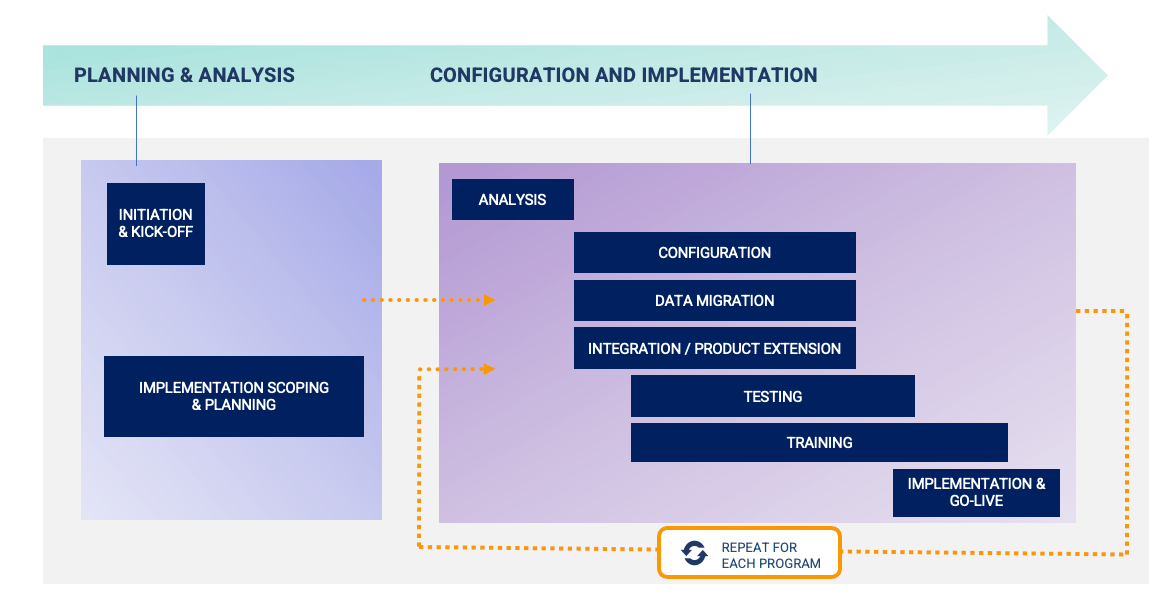
So, during that planning phase, or the ‘initial analysis and design phase’, your questions may be different in your business environment, but here are the type of questions we often ask our clients to bring out the best results:
Business Process Design
- What are the business drivers for process improvement?
- Where do errors often occur within the process?
- What steps in the process take the longest? Where are the bottlenecks?
- What opportunities exist for automation?
- Does this step require thought and decision making?
High-Level Business Process Analysis / Gap Identification
- What is the goal of this specific process?
- What defines how the process must occur? e.g., rules and regulations
- What triggers the process?
- What information/resources (i.e., documents) feed into and out of the process?
Legacy Systems Analysis / Data Migration Design
- Are there known data quality issues/concerns in the system?
- Have users changed usage of the system (or areas of the system) over the years?
- What was the evolution of this system?
“In strong business processes, questions are key in the analysis and design phase.”
Kevin Lyons, Project Manager, Windsor
The point is; we know to go beyond the technical and get into the ‘for sake of what’ questions and dig for answers, because it strengthens the results for our clients. So – we find that the more we slow down and dig deep and collaborate with the client during the planning and design phase, the stronger the software implementation will be.

Next, during both planning and implementation, we use formalized processes and best business practices. You’ve probably heard of ‘Plan/Do/Check/Act’; an iterative method used for improving business processes and products. We use methods such as the Business Process Design and global-system process models such as a Ericksson-Penker diagram as a means to help our clients visualize the end results with us (we eventually bring in other methods such as Agile-Scrum process framework for configuration and testing etc.).
Even though we configure Windsor’s existing software products on behalf of clients, Windsor project managers have a strong software development background, and that gives us the know-how to bring about a strong user experience and excellent results for our clients, even when integrating and configuring an existing but flexible software platform.
Conclusion: going beyond the technical brings stronger results
The questions that you ask from prospective vendors during a vendor selection process differ for everyone. As part of your questions and requirements, we recommend that you consider more than technical specs. Also, avoid limiting vendors only to replicating exactly how you do things today. Include your goals, and include questions around the implementation. Look for how the vendor will truly partner with you.
It takes collective experience and wisdom to ask that perfect question. We keep on growing in our abilities to ask the best questions and we appreciate our clients’ competences and their passion for positive change.
About Windsor Solutions
All environmental agencies have unlimited environmental challenges but with limited resources. At Windsor, we have helped simplify and streamline the work of governmental agencies across all states. Our job has been to enable them to be better at their tasks, which includes helping them with quicker visibility, stronger workflow efficiencies and better tools to act with precision.
We invite vendors to ask us questions ahead of vendor selection processes to learn what other technical strategies may be possible.
If you’d like to comment on this blog or contact us, we’d love to hear from you.
Author: Kevin Lyons
#windsorsolutions, #environmentaldataecosystem, #environmentaltech, #environmentalitsystems, #nVIRO, #nSPECT, #nFORM, #environmentalcouncil, #stateagency, #climatechange, #DEQ, #EPA

Leave a Reply